


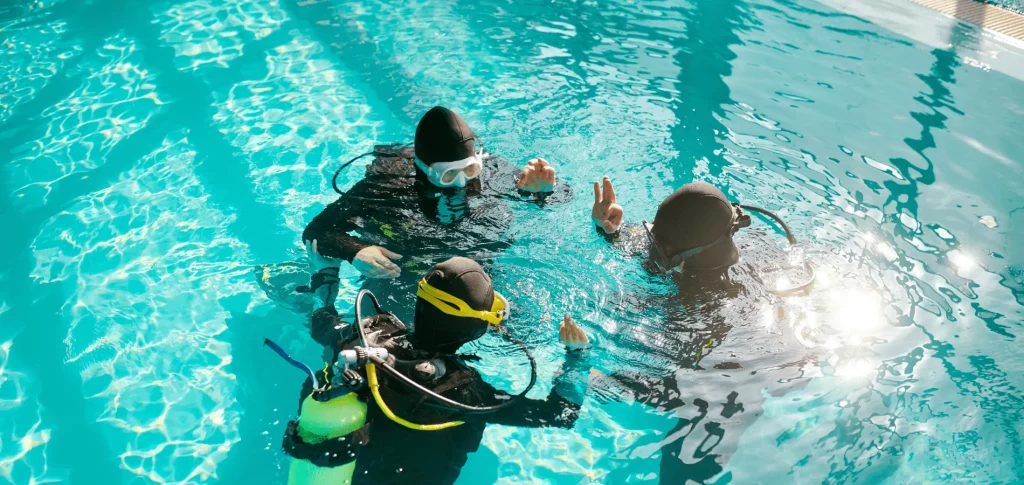
Winter diving: Reasons to try it
It's not just a cliché. It's something that's repeated season after season.
At Mola Mola Dive, we see every year how students who choose to dive in winter develop skills faster, gain better buoyancy control, and arrive in summer with a confidence that others take months to achieve. When the warmer months arrive, they're not just starting to learn… they're enjoying themselves.
And the reason is simple: winter is not more difficult, it is more formative.
Less visibility, better learning
It may be surprising, but perfect visibility doesn't always help with learning. When everything is crystal clear, the student relies too heavily on sight and doesn't develop other essential diving skills.
Under ideal conditions anyone can feel comfortable, but a diver is built when he learns to interpret the environment, not just look at it.
You learn how to really find your way around
In winter, water visibility is usually reduced. This necessitates addressing fundamental aspects from the very first dive:
- real buoyancy control without distant references
- Use of background and relief as a guide
- constant communication with the partner
- Pay attention to the instructor and the immediate environment.
- reading of bodily currents and sensations
The student stops “walking” and begins to conscious diving. Then, when you dive in the summer with clear water, everything becomes easy because you've already internalized the basics.
Greater control of air consumption
One of the biggest problems for beginner divers is rapid breathing, usually due to stress. Winter helps to eliminate this.
Under more neutral conditions, the student learns from the beginning to:
- relax before going down
- control breathing rate
- move slowly
- avoid unnecessary flapping
- maintain depth effortlessly
That's why many divers trained in winter consume less air from their first dives and naturally lengthen their bottom times.
The cold: an important (but controlled) factor
Yes, the water is colder. But cold doesn't mean discomfort if the equipment is right.
Temperature becomes part of the learning process: the student understands the importance of calmness, breathing, and planning.
Thermal equipment included
At Mola Mola Dive we use equipment designed for the cold season:
- thick diving suits
- thermal hood
- gloves
- booties
- complete protection against heat loss
The goal is for the student to be comfortable so they can focus on learning, not on the temperature. After the first few minutes, the feeling is usually neutral.
The body adapts quickly
The initial sensation lasts only a very short time. As soon as breathing stabilizes, the body reaches thermal equilibrium.
Most students say the same thing after their first winter dive: they were fine in the water… but the cold is noticeable when they get out. The limit is usually mental, not physical.
Why winter is the best time for the open water course
Winter completely changes the way you learn and is one of the best times to do it. Open Water Course in winter.
Small groups
The instructor can focus on each student individually. This means immediate corrections, well-understood exercises, and steady progress.
More time with your instructor
No rushing or rotations. Each skill is repeated until it becomes second nature: mask clearing, buoyancy control, regulator retrieval, and controlled ascents.
Heated pool for a comfortable start
The first breaths underwater are taken in a calm and warm environment, eliminating initial nerves and facilitating adaptation.
Without overcrowding
Fewer people means:
- less noise
- more concentration
- better communication
- more security
- more relaxed experience
Better quality and better price
The off-season allows you to dedicate more time to the student and also take advantage of more affordable rates.
Real benefits for your future as a diver
More confidence all year round
Anyone who chooses to dive in winter can dive in any season. Comfort doesn't depend on temperature or visibility.
In summer everything will seem easy to you
When warm, clear waters arrive, something curious happens: the student trained in winter is no longer learning… he is enjoying himself.
- It consumes less air.
- Controls buoyancy without thinking
- stay calm
- observe more wildlife
The change is evident even to the diver himself.
Conclusion
Winter isn't the difficult season for diving. It's the learning season.
Diving in winter offers you:
- more robust learning
- greater security
- adaptation to any condition
- better air control
- more personalized experience
And when summer arrives, you simply enjoy it from day one.